Solvay sustainability approach for responsible chemistry
Our sustainability work is built around safer operations, lower-impact material pathways, and transparent reporting. Claims are connected to recognized methods such as ISO 14040 life-cycle assessment, OECD biodegradation tests where relevant, and SDS-based hazard communication.
People: safety, skills, and responsible operations
Solvay's people pillar focuses on process safety, occupational health, technical training, and accountable supplier expectations. Chemical handling is communicated through SDS sections, GHS classification, exposure controls, and emergency guidance. We avoid broad "non-toxic" language because safe use depends on concentration, route of exposure, operating controls, and final application.
Planet: carbon, water, and circular feedstock discipline
Lower-carbon chemistry requires more than green language. For selected products, Solvay evaluates cradle-to-gate CO2e, energy mix, recycled or bio-attributed inputs, and water intensity. Where biodegradability is discussed, it must be tied to an appropriate OECD 301, 302, or 310 method rather than a generic eco-friendly claim.
Materials: circular design with performance evidence
Engineering polymers cannot be redesigned on sustainability intent alone. Solvay evaluates thermal performance, mechanical properties, chemical resistance, processing windows, impurity controls, and regulatory status alongside circular content. A material with lower carbon intensity must still pass the application test plan defined by the customer.
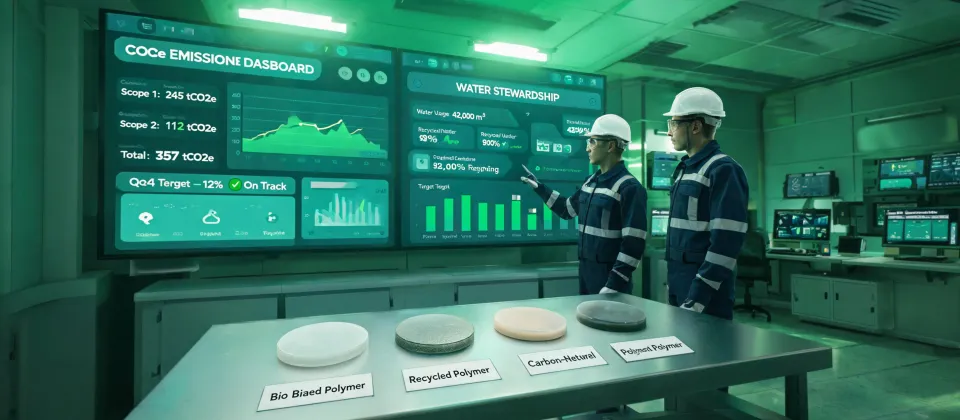
Sustainability dashboard overview
The dashboard is designed for practical customer review. It separates operational performance, product-level assumptions, and supplier expectations so teams can decide which data belongs in procurement scorecards, engineering files, or customer-facing sustainability disclosures. Solvay recommends confirming reporting boundaries before comparing materials across suppliers.
| Area | Indicator | Review method |
|---|---|---|
| Climate | CO2e intensity | ISO 14064 inventory and product LCA boundaries |
| Circularity | Recycled or bio-attributed feedstock | Mass-balance chain-of-custody review |
| Safety | Hazard communication | SDS Section 2 and GHS classification |
| Water | Reuse and discharge quality | Site-level water stewardship plan |
| Suppliers | Responsible sourcing | Supplier code and audit escalation |
Explore sustainable polymer solutions with evidence attached
Discuss material data, document availability, and application limits before claims enter your own customer-facing specification.